Showing posts with label hdtv. Show all posts

Thursday, November 30, 2006

AVCHD vs. HDV

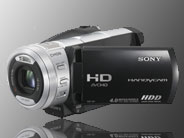
Sony, Panasonic and some other companies recently introduced the AVCHD format, which records high definition H.264-encoded video to tapeless media, such as DVD-Rs, flash cards, HDDs, etc.

AVCHD is going to replace HDV and be the HD video recording standard for the mass market. The new codec potentially allows the video to be about 40% less in size while maintaining about the same perceived quality as HDV (which records MPEG-2 compressed HD video to standard miniDV cassettes).

A German site published a review of Sony's first-generation AVCHD cameras in comparison of an equal-grade HDV camcorder, and the results are quite optimistic for the new format. The author doesn't make any conclusions (as far as I understood from the automatic translation, which is not so good), but I've compared several screenshots and I can't say that one format is worse that the other. This is actually a rather promising result as for the first generation of the technology (remember, it's just a start).

I noticed an interesting situation on forums of prosumer (and lower-end professional) video camera users where they mostly discuss which camcorder is better and why. Once they learned about the new format, they (mostly) started to criticize it, saying that they will stick with the old good HDV, which is more "serious", is better "because of lesser compression", and so on. It is funny to see because several years ago they were saying the same about HDV. They hated it because of the MPEG-2 compression, etc, etc, etc, and now they (probably even the same people) are fans of HDV, fighting against a newer standard. This is a fundamentally wrong position. I don't say that all new things are better then old, but most are. And the HDV-AVCHD situation is a perfect example - the future inevitably will come, and these people will enjoy the new recording format.

Monday, November 27, 2006

HDTV is the Hot Topic

This blog is certainly not only about high tefinition video, I'm going to write about any interesting gadget-related topics, but it looks like today HD is the hottest topic. I remember that when I read an archive of a 19th century technology magazine (yes, they had technology magazines in 19th century!), the they devoted most of the attention to telegraph. Can you imagine, telegraph was the coolest gadget of that time! Speaking of the present age, previous hot topics were about thing like mobile phones, digital cameras, DVDs, MP3 players and other things like that. What will be next? We'll see.

Also, HD video is currently a challenge for virtually all aspects of digital technology: processing power (not all modern computers can even play HD video at 60 FPS), display, internet bandwidth (to distribute those heavy HD clips over the Internet), digital video cameras, storage (all that Blu-Ray & HD DVD stuff), software. And that's why it's interesting - it wouldn't be interesting it it had no challenge.

Sunday, November 26, 2006

The Progressive HD Framerate Initiative

It's time to stop the confusion that arises when people speak about progresssive video resolutions (such as 720p and 1080p). Here is an example: you are told about a HD camcorder that shoots in 720p. But only after you dig deeper into information about this model you realize that it acutally shoots in 30p, not 60p! Half the framerate - 30p and 60p are two big differences. Or you read about a piece of hardware that displays "gorgeous 1080p". How do you know whether it can accept 60 frames per second signal from your PS3, which is really cool, or the best thing it can do is to inverse telecine 1080i movies to display them progressively at 24 FPS (which any decent HDTV must do by default)? Or when you are going to download a HD video clip from the internet, how do you know is it 24 FPS, 25/30 FPS or stunning 50/60 FPS?

So, the initiative is to make everyone

Always specify frame rate when
speaking about a HD video resolution,
like "1080p/24" or "720p/60".

So simple, and so useful! Whenever you write "1080p" or "720p" on a web site, in a forum or wherever else, just add two more digits and the information becomes much more valuable. And spead the word about this rule, and let's make the HD world a little better!

Digg!


Update: But how about the difference between "European" 50 FPS and "American" 60 FPS, you ask? Well, if you are wriring about a specific video footage that is already shot (or going to be shot) in one of the framerates, you specify the framerate exactly as it is. If you are speaking about a tv that can display 1080p/60, it is obvoius that it can also display 50 FPS of the same resolution, so just write either "1080p/60" or "1080p/50" and don't worry about that. The same generally goes to camcorders, but among them there may be exceptions, so it would be fine to reference exactly which frame rates a camcorder can handle if you are saying about its capabilities.

Saturday, November 25, 2006

What I like in Xbox 360 (technically)

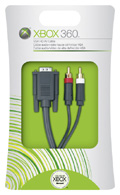
What I like in Xbox 360 (theoretically, so far, as I don't yet own one) is its ability to plug into a computer monitor, supporting also the 1280x1024 resolution (which is the most common on today's computer monitors). Why would anybody play console games on a computer monitor? It appears that there are reasons. I'll write about it some day.

Friday, November 24, 2006

HDTV Format Wars: 720p vs 1080i

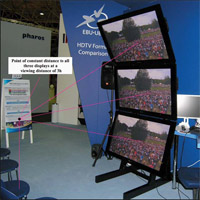
For people without advanced technical knowledge of HDTV it is hard to believe that the 720p format (720 progressive lines per frame at 50/60 frames per second) is actually not only not worser, but generally a little better than 1080i (which has 50/60 interlaced 1920x540 fields per second that theoretically comprise a huge 1920x1080 frame). I'm not going to spend the whole day convincing you (I just feel too lazy for that :), but I have a couple of smart links for you to read (both documents come from some smart people at European Broadcasting Union):
Conclusion: 720p delivers the same image quality as 1080i on uncompressed footage, and even better on compressed video (as 720p is more efficient for modern compression aplgorithms). That's why 720p is the Europe's recommended broadcasting standard.

Now I want to answer two questions that you probably want to ask after reading those articles:

Why was 1080i initially added to the HDTV inventory?
Because it happened a long time ago, when CRT displays were popular. Interlaced video was good for CRT, but it isn't good for modern display types that are all progressive (LCD, plasma, 100 Hz TVs, DLP, etc).

Why 1080i is more widely used now by actual HDTV channels than 720p?
It's all about marketing. Bigger numbers. Marketing people aren't techies, they have a hard time seeing actual difference between the two formats. And if they look the same, they simply promote that one that has bigger numbers. Because if they choose lower numbers, their competitors would choose bigger ones and tell the masses that they are cooler, and the masses will believe them (judging from the numbers, of course).

But to be completely fair, I must say that there is one case when 1080i is better. It is better for low-framerate footage, like cinema. But only if your HDTV performs proper inverse telecine. So, 1080i can be the format of choice, say, for a channel that mostly broadcasts 24p movies.

Next Generation Consoles

It is clear that "next generation" is not only about computing horsepower. Innovative gameplay, that's what [also] matters. Wii has its motion-sensing wiimote (but it looks like it's going to be the only advandage of Wii, as it is not much more powerful that the old Gamecube), PlayStation has the SIXAXIS controlled and the EyeToy, Xbox doesn't seem to have anything like that so far.

Image from washingtonpost.com